Address
Zahra Perfumes
Athani, Cochin
Kerala-683585
8921824742
Work Hours
Monday to Friday: 7AM - 7PM
Weekend: 10AM - 5PM
Address
Zahra Perfumes
Athani, Cochin
Kerala-683585
8921824742
Work Hours
Monday to Friday: 7AM - 7PM
Weekend: 10AM - 5PM
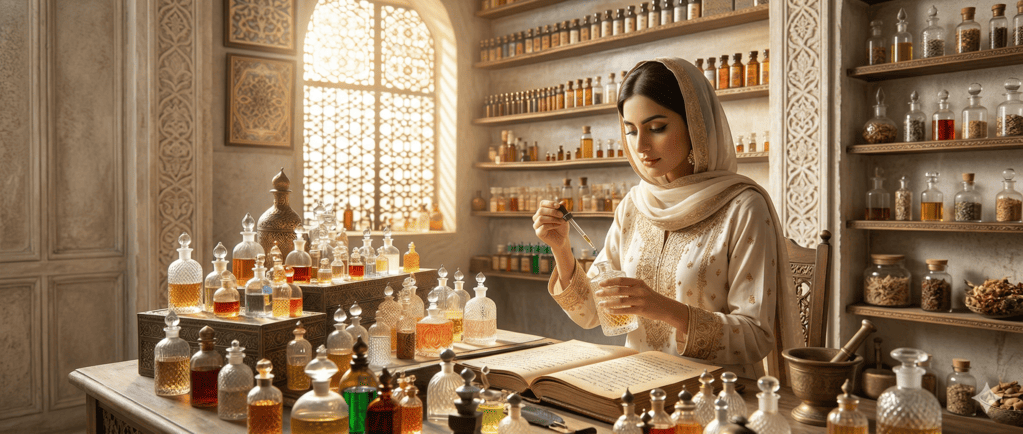
Long before the glass bottles of modern designer perfumes lined department store shelves, the world smelled of attar. Derived from the Arabic word for “scent,” attar (also known as ittar) is a highly concentrated, all-natural botanical perfume oil. Unlike modern perfumes that rely heavily on synthetic molecules and alcohol bases, authentic attar is an ancient craft of hydro-distillation, capturing the pure essence of flowers, herbs, spices, and even the earth itself.
While the earliest roots of botanical perfumes trace back to ancient Egypt and the pioneering distillation techniques of the Persian physician Ibn Sina in the 10th century, the soul of attar today resides in Kannauj, a small city in Uttar Pradesh, India.
Often referred to as the “Grasse of the East,” Kannauj has been a hub of perfumery for thousands of years. It reached its zenith during the Mughal Empire. Historical lore suggests that the Mughal Emperor Jahangir and his queen, Noor Jahan, were the city’s first great royal patrons, famously popularizing the luxurious Ruh Gulab (rose attar) after being captivated by the scent of rose petals in her bath. Today, generations of artisans in Kannauj continue to preserve this legacy, operating traditional distilleries tucked away in the city’s narrow lanes.
What makes true attar so remarkable is not just what it is made of, but how it is made. The artisans of Kannauj still rely on a centuries-old, painstaking method known as Deg-Bhapka. It is a marvel of sustainable, low-tech engineering that requires no electricity or heavy machinery—only fire, water, copper, and human intuition.
The process involves several key, traditional components:
Throughout the distillation, the master craftsman (the digaha) constantly monitors the heat by listening to the hiss of the steam and feeling the temperature of the pots with bare hands. It is a sensory art form that cannot be replicated by modern machines.
Because attar is rooted in nature, its varieties are as diverse as the botanical world itself. Some of the most celebrated types include:
In a world dominated by mass-produced, alcohol-based sprays, attar remains a testament to slow, intentional craftsmanship. Because it is completely natural and highly concentrated, just a tiny drop on the pulse points can evolve and linger on the skin for days.
While the attar industry has faced modern challenges—including the rising costs of raw materials like sandalwood and the influx of cheaper, synthetic alternatives—a renewed global interest in organic, artisanal, and sustainable products is breathing new life into the craft. For those seeking a fragrance with history, depth, and a true connection to the earth, attar is nothing short of magic in a bottle.